My old room was eleven feet by nine. I remember those dimensions as clearly as my phone number because I measured them four times over two years, hoping that, through some magic angle, the room would yield more square footage than it actually had.
Before you start changing your bedroom, it helps to get rid of things you no longer need and organize what you already have.
If you need simple ideas, check out my post on 15 Small Bedroom Organization Ideas for a Cozy Fall Refresh. It can help you make better use of your bedroom space and keep the room from feeling crowded.
It never happened. The transformation wasn’t about the room; it was about understanding what belonged in it based on what it did, not where it sat.
If you are working with a really small bedroom, you may need to think carefully about how you use every part of the room.
For more ideas, take a look at my post on 20 Very Small Bedroom Ideas, where I share simple ways to make a small bedroom more useful and comfortable.
Once I started treating the renovation as something to be decided, the room transformed itself in ways I couldn’t have imagined. Here is what really worked.
Maximizing space is not only about storage and furniture. You also want the bedroom to feel comfortable and inviting.
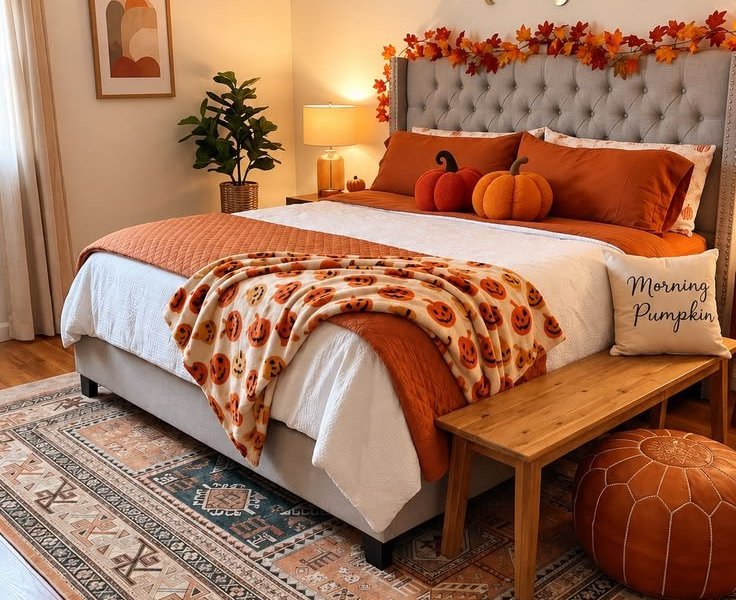
If you are looking for simple ways to create a warm bedroom, read How to Make a Small Bedroom Feel Cozy for Fall for more ideas.
1. Start with what you’re willing to remove, not what you want to add.
Everyone automatically thinks to use Pinterest to look at shelving-unit boards when they are out of space.
That’s what I did, but it failed me miserably because I kept creating space for items I didn’t even need in the first place.
My successful renovation all began when I decided to clear out everything from the room and take back only the items that deserved a place there.
And with that single move, half of my “furniture problem” disappeared.
2. Build up, not out
My ceiling height was nine feet, and for the last two years, I’ve been using only about six feet of that.
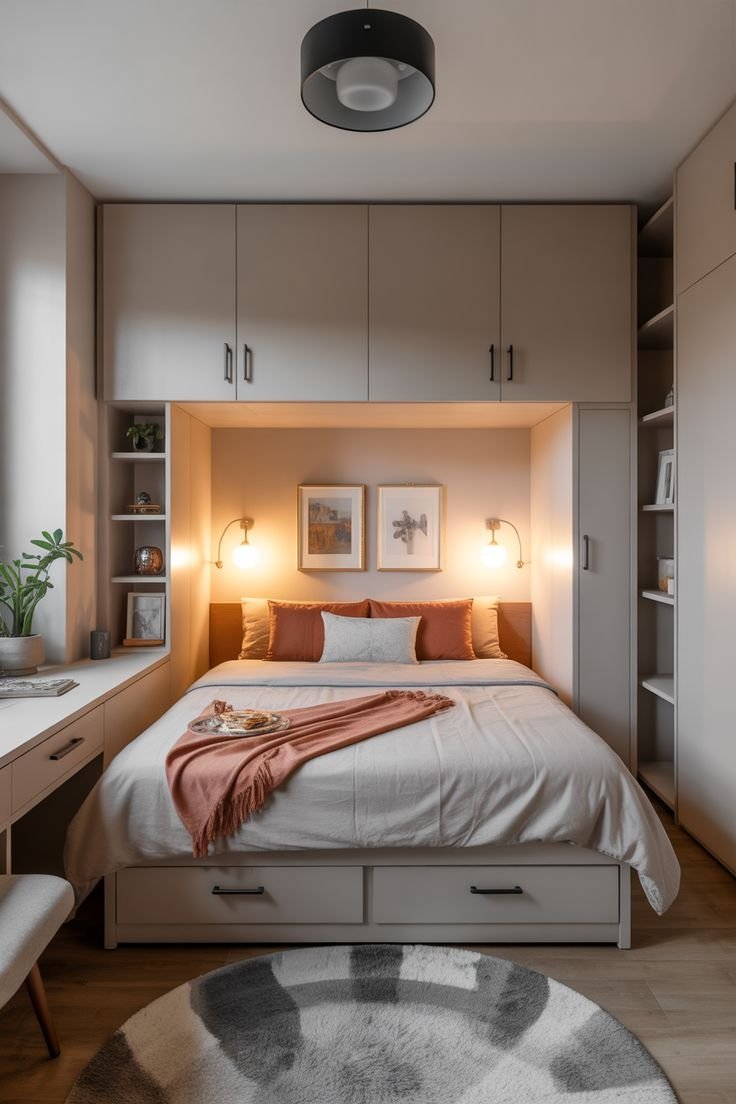
There was this tall, thin bookcase along one wall of the room that provided much more storage space than any broad dresser ever did, while taking up only a third of the floor space.
So, if you’re redoing the place, it’s the time to trade everything broad and low for something tall and thin.
Because with that single act, the floor stays open and the room feels bigger without moving a single wall
3. Choose a bed that does two jobs.
I avoided a storage bed for quite some time because the ones I had come across seemed bulky.
However, I discovered a platform bed with drawers in its frame and realized I had been tackling the wrong problem.
The clothes I wear in the off-season, extra linens, and a huge collection of phone chargers now live under that bed. If you can afford one major piece of furniture to replace, this is the one.
4. Mount instead of stack
Lamps, charging cords for your cell phone, even a tiny dish for your jewelry and coins, all of which had been sitting on a nightstand that was really just a miniature table, doing a table’s job poorly.
Sconces and shelves solved the problem, making space for everything without taking up any room. It’s a minor adjustment, but you’ll notice it every night because you’ll have space for your glass of water.
5. One big mirror beats five small mirrors
When I used the gallery-wall method using small decorative mirrors, my wall became overcrowded rather than spacious.
One big mirror hanging opposite the window, not adjacent to it, has a unique effect no cluster can match: it reflects light into the room.
When remodeling your room, this is one of the least expensive yet most striking things you can do.
6. Let the closet do more work
I then moved on to the closet, removing all its contents before buying any new pieces of furniture.
Adding a secondary bar for hanging and folded clothes doubled the storage space. Slim velvet hangers, instead of heavy plastic ones, also let me gain extra space on the bar.
7. Ask the dresser to justify its footprint.
By now, you might be wondering: What about the dresser? Well, an average dresser with six drawers takes up six or seven square feet on your floor.
That’s a lot of your available space for one piece of furniture, and it has two drawers full of items you no longer use and don’t even notice.
This is the time to open all drawers during the renovation and decide whether you need that piece of furniture. I decided I didn’t.
8. Go sheer on the windows.
The heavy drapes were the final touches in my renovation, mainly because I didn’t realize how much impact they had.
By changing them to sheer drapes, we let in more sunlight, and nothing makes a small space feel bigger like sunlight.
9. Pick one focal point and let it work alone.
The small space gets even more cluttered when each wall has something to say. I selected only one wall, facing the entry door,
decorated it with a single work of art and better lighting and left the other three blank. This room has a sense of purpose because the eyes have something to focus on.
10. Design the layout around movement, not furniture.
The final change, and in all seriousness the most important change, that I made to my bedroom involved the way that I walked through the room.
Instead of placing the furniture first and then trying to figure out how I was going to walk through it, I plotted a route that started at the entrance, went to bed, and ended in the closet before building around that path.
Frequently Asked Questions
So, if you want to know what’s the cheapest way to make a small bedroom feel bigger?
Swapping heavy curtains for sheer ones and adding a large mirror opposite the window are the two lowest-cost changes on this list, and often the most noticeable. You can do both in an afternoon for a fraction of the cost of new furniture.
Do storage beds actually make a difference?
Yes, a platform bed with built-in drawers can absorb an entire off-season wardrobe or set of spare linens, which is often enough to eliminate the need for a separate dresser.
Should I paint a small bedroom a dark color to make it feel cozy, or light to make it feel bigger?
Light, warm tones (cream, pale sage, soft warm gray) reflect more light and generally make a small room read as larger and calmer. Dark colors can feel cozy in the right setting, but they tend to shrink a room that’s already tight on space.
Does a loft bed a good option for adults, not just kids or students?
Yes, as long as ceiling height allows for it comfortably, nine feet or more is ideal. The real value is what goes underneath: a desk, a reading nook, or extra storage, effectively turning one room into two functional spaces.
How do I know where to start if the whole room feels overwhelming?
Pick whichever single thing bothers you most day-to-day — an overcrowded dresser, a dark corner, a cluttered nightstand — and fix that one thing first. Small rooms respond better to one deliberate change at a time than to an all-at-once overhaul.
Conclusion.
This transformation didn’t require moving any walls or employing contractors for months on end.
It simply involved taking another look at the room I had stopped truly seeing and making sure that every square foot was justified.
Start with whatever bothers you most in your own space; in my case, it was the dresser, but in yours it could be the curtains, nightstand, or even the closet you never use.